Germany From Above

Nolan O'Connor
| 22-08-2026
 · Travel team
Germany’s landscapes look very different from above. Beyond its cities are Alpine peaks, dense forests, sandstone formations and Baltic cliffs, many of them accessible without demanding mountaineering experience.
From Germany’s highest summit to a treetop walkway in the Black Forest, these six viewpoints offer some of the country’s most memorable panoramas.
1. Zugspitze, Bavaria
At 2,962 metres, Zugspitze is Germany’s highest mountain. Its summit sits directly on the Austrian border and, in clear weather, opens onto hundreds of Alpine peaks stretching across Germany, Austria, Italy and Switzerland.
Reaching the top does not require a full mountain ascent. Visitors can use the cable car or combine the cogwheel train with the Gletscherbahn for a more scenic journey.
The summit is particularly impressive on crisp mornings when visibility is strongest.
Price: €78 for a return Zugspitze ticket during the 2026 summer season. A combined return journey from Munich, including the mountain ticket, costs €94.50.
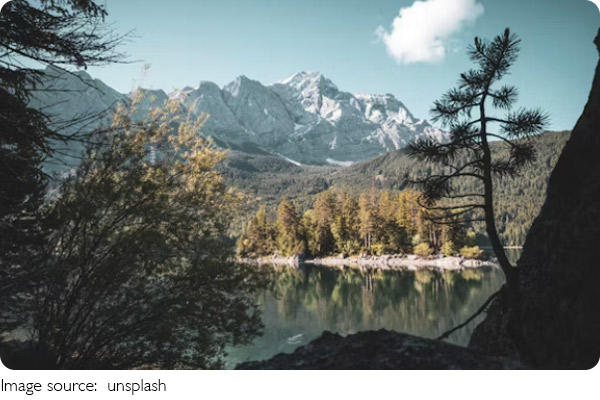
Zugspitze, Bavaria
2. Bergpark Wilhelmshöhe, Kassel
Kassel offers a completely different kind of elevated view.
Bergpark Wilhelmshöhe covers around 560 hectares and has been recognised as a UNESCO World Heritage Site since 2013. Its most famous landmark is the monumental Hercules statue, standing high above a series of historic water features.
From the upper part of the park, visitors can look down towards Wilhelmshöhe Palace, Löwenburg and the city beyond. On particularly clear days, distant mountain ranges appear on the horizon.
The park is best explored slowly, allowing several hours for the paths, viewpoints and historic structures.
Price: walking through the park itself is free, although individual attractions may charge admission.
3. Berlin Gasometer
Berlin is usually explored at street level, but Schöneberg offers a more unusual perspective.
The former Gasometer, constructed in the early 20th century, rises almost 80 metres above the surrounding neighbourhood. Its elevated Sky Lounge and terrace provide views towards landmarks including the Reichstag, Victory Column and central Berlin skyline.
Unlike the city’s conventional observation towers, the industrial structure gives the panorama a distinctly architectural character.
Access can depend on events and opening arrangements, so checking availability before visiting is important.
4. Black Forest Treetop Walk
In Bad Wildbad, visitors can rise gradually above the forest rather than climbing a mountain.
The treetop walkway stretches for approximately 1,250 metres before reaching a 40-metre observation tower. The path is designed as a gentle ascent, making it accessible to a wider range of visitors than many mountain viewpoints.
From the top, the view extends across the Black Forest and Enz Valley. In particularly clear conditions, distant landmarks around Stuttgart and the Swabian Jura may also be visible.
Allow roughly one to two hours if you want to enjoy the route without rushing.
5. Königsstuhl, Rügen
On Germany’s Baltic coast, the Königsstuhl offers one of the country’s most striking sea views.
The famous chalk cliffs rise above the coast of Jasmund National Park on Rügen, Germany’s largest island. A modern Skywalk now extends over the cliff area, creating sweeping views of the Baltic, white rock faces and surrounding beech forest.
The attraction combines the viewpoint with exhibitions and information about the national park.
Price: €14, including access to the Skywalk and other facilities at the National Park Centre. A family ticket costs €30.
6. Bastei Bridge, Saxony
Few German viewpoints are as instantly recognisable as the Bastei.
The stone bridge crosses a group of dramatic sandstone formations high above the Elbe Valley in Saxon Switzerland. The surrounding landscape feels almost theatrical, with narrow rock towers rising from densely wooded slopes.
The bridge also connects with trails leading through the formations and towards the remains of the medieval Neurathen rock castle.
The viewpoint is accessible throughout the year, but early morning and evening are usually more atmospheric and less crowded than the middle of the day.
Price: access to the main Bastei viewpoint and bridge is free, making it one of the most affordable stops on this list.
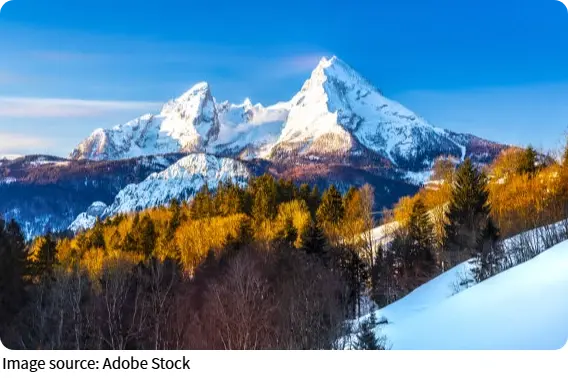
Which Viewpoint to Choose?
For a true mountain panorama, Zugspitze is difficult to beat. Königsstuhl works best for coastal scenery, while Bastei combines hiking with remarkable geology. Bad Wildbad is a gentler option for families, and Kassel mixes landscape with history and architecture.
For a trip focused on several viewpoints, allow around €45–€75 per person per day excluding accommodation for meals, local transport and everyday expenses, with major attractions such as Zugspitze added separately.
Germany’s best elevated viewpoints are surprisingly varied: one day can mean standing above Alpine glaciers, while another brings Baltic cliffs, forest canopies or sandstone towers stretching towards the horizon.